
The strange, the menacing, the horrific, the terrifying: these only made their way into comics relatively late, unlike eroticism, for example. In the United States in the 1930s and even the 1940s, when comics drew inspiration from pulp magazines (a kind of cheap illustrated fiction dealing with genre themes), horror and romance were the only traditionally popular major genres not to provide substantial source material for comics.
It was not until the early 1950s, spurred by EC Comics and William Gaines, that a wave of horror comics swept across North America. To be sure, a number of horror series centered on monsters had already existed for about a decade, but EC's comics quickly distinguished themselves through the care lavished on the artwork—with genuine visual boldness—and the scripts (though the latter were not particularly remarkable). The horror in these comics went further than in many American films of the 1950s. Three titles stand out: The Vault of Horror, The Crypt of Terror and The Haunt of Fear.
From the decorative to the existential
The violence in these titles (and others) would later spark a heated debate across the Atlantic, culminating in hearings before the U.S. Senate (including one featuring Gaines) and the comics industry's establishment of the Comics Code Authority. But the genre persisted despite censorship, notably in magazines with a different format from comic books.
In the 1960s, creators such as Berni Wrightson and Neil Adams emerged, alongside Warren publications (Creepy, 1964, and Eerie, 1965). In the 1970s, Wrightson would launch the Swamp Thing series. Under Alan Moore's direction from 1983 to 1987, after a lengthy hiatus, it would become one of the most compelling horror comics, blending the genre's classic elements with political themes and philosophical reflection. Moore—even though several of his works remain highly « graphic »—strongly emphasizes the psychological dimension of horror in comics.
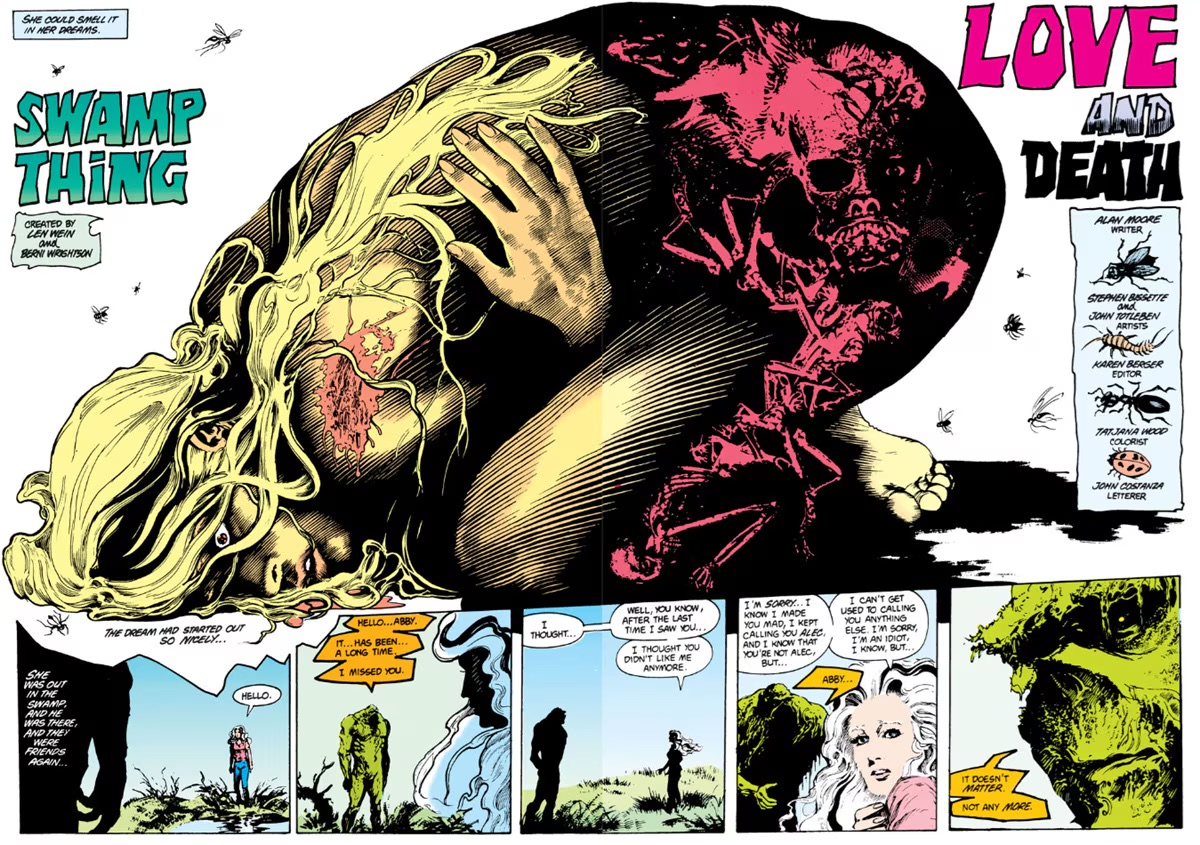
Interestingly, one of the very first issues of Swamp Thing1 that Moore scripted would completely reinvent the character, as a metaphor for a shift from « decorative » horror to existential horror. This same episode also contains one of those memorable lines Moore is so good at: « Yes, I rather think there will be blood. Lots of blood. Blood in extraordinary quantities. »
The warm body of History
One of the Swamp Thing artists, Steve Bissette, would later launch an anthology called Taboo, bringing together some of the genre's greatest creators from 1989 to 1995. It was in Taboo, beginning in 1989, that Alan Moore and Eddie Campbell's masterpiece, From Hell, was created. Its publication would encounter many setbacks (Taboo had to fold, the project was successively taken over by Tundra Publishing and Kitchen Sink, both of which disappeared, and From Hell would not be completed until 1998).
Subtitled Being a Melodrama in Sixteen Parts, the work is dedicated to the five victims of the notorious Jack the Ripper, a murderer whose savage crimes in London's Whitechapel district in 1888 made headlines and were never solved. Moore develops a controversial theory about the murderer's identity, while acknowledging that this choice is pure creative license, allowing him to portray the many layers of Victorian society, Freemasonry among them. Another major theme in From Hell (already glimpsed in Watchmen) is the idea that the passage of time is an illusion.
Speaking of William Withey Gull, a physician born in 1816 and the culprit in From Hell, Moore writes: « From my part, I am concerned with cutting and examining the still-warm corpse of history itself. In some of my chilliest moments, I suspect that this was his foremost preöcuppation also, albeit in pursuit of different ends... »
If From Hell has made such a mark on the history of horror comics, it is not only because of its meticulous historical reconstruction and Eddie Campbell's drawing, both rigorously classical and subtly deconstructed (Bacchus, Alex), but also—as is often the case with Moore—because of the narrative's construction, the quality of the writing, and the way he controls its pace through panel layout. Moore and Campbell also repeat panels as one might repeat musical motifs.
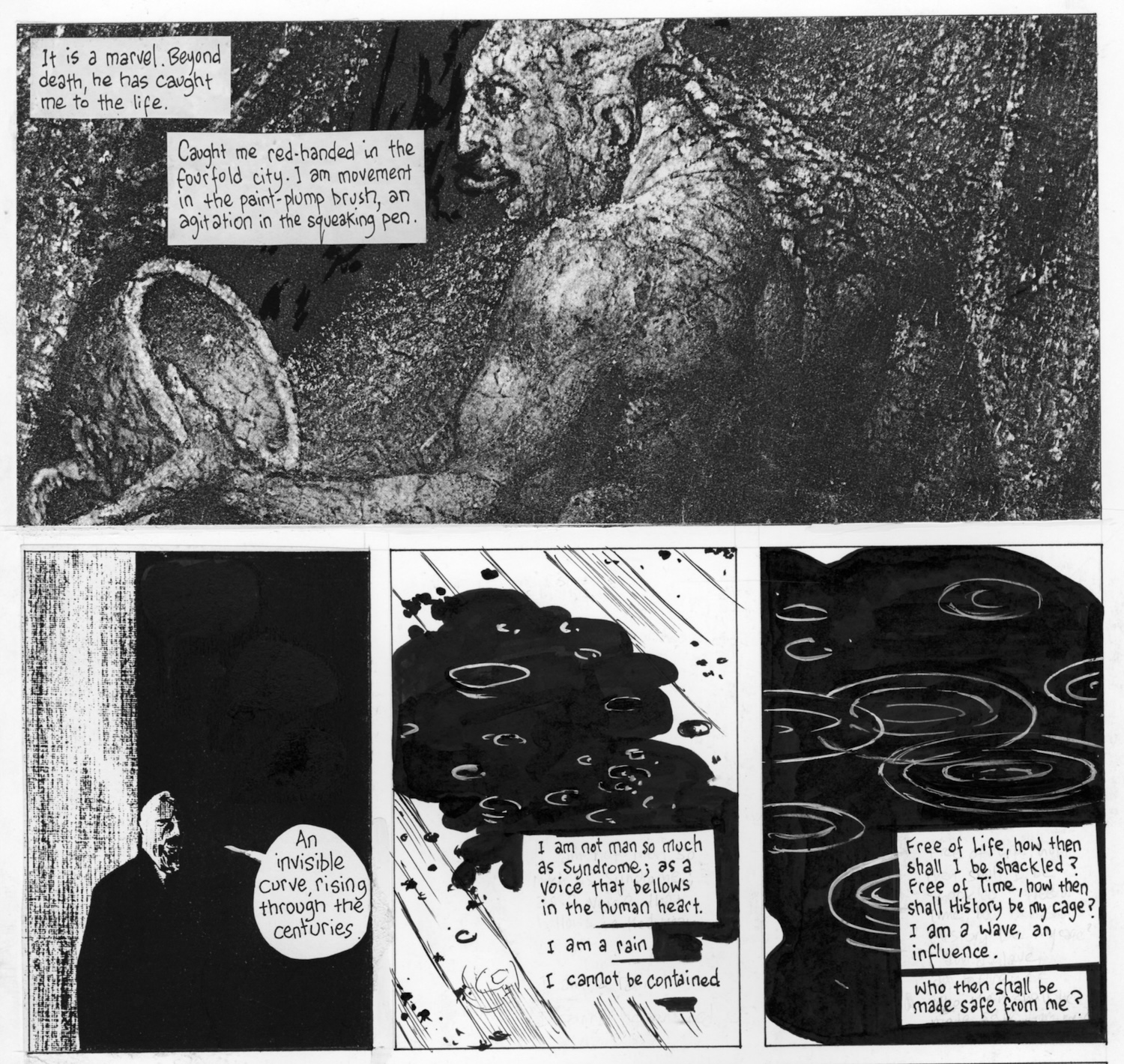
And the final chapter (Gull, Ascending) offers a surprising reflection on the architecture of history, on correspondences and the repetition of similar events in distant times and places. Moore wisely draws no conclusions, instead juxtaposing facts that do reveal a common thread, but seem more in keeping with the characters than with any desire to impose an interpretation.
Cosmic horror
Alan Moore is known to be interested in occultism; he even calls himself a « magician ». But Moore is also a great realist, and his approach to the supernatural seems to rely more on a metaphorical connection with the quasi-spiritual act of creation. On these subjects, he seems rather Platonic: magic and myths have a real existence as ideas.
It is quite natural, then, that in the 2000s and 2010s Alan Moore would delve into the work of H. P. Lovecraft (1890–1937), the master of cosmic horror, whose stories teem with lurking, nameless abominations. In Neonomicon2 (Avatar, 2011), Moore sets Lovecraftian creatures in a contemporary setting, but this is more than a change of scenery: Lovecraft's existential anxiety takes on a new, intensely sexual form.
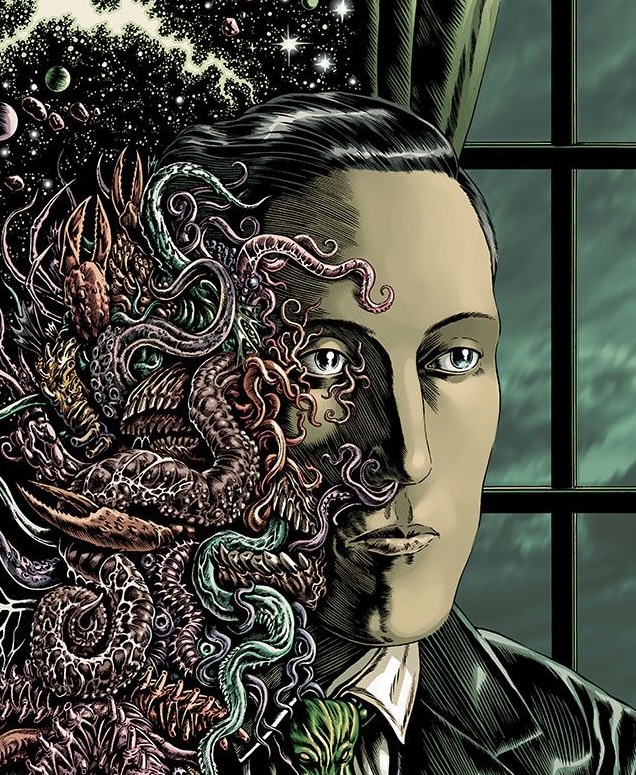
In the series Providence (also published by Avatar, 2015–2017), Moore uses an investigation to deconstruct Lovecraft's anxieties and obsessions even more deeply, while grounding the story in historical reality. Once again, he offers his own symbolism, using horror as a means of uncovering identity and exploring truths.
◆