
Hugo Pratt was not the first European comics creator to explore adult themes, but his work—aimed at teenagers through its adventure-story appeal and at adults through the complexity of its characters' feelings—was among the first to be treated by the press and intellectuals as the work of a novelist or filmmaker.
Pratt and his signature character, Corto Maltese, are often discussed beyond the world of comics: by travelers, enthusiasts of Kabbalah and other rituals and legends, and readers who see them as heirs to writers such as Conrad and Melville. The political, mystical, and mysterious dimensions of his work, his admirable gifts as an illustrator and watercolorist, and his life itself have kept the man (and his characters) a source of fascination more than 30 years after his death in 1995.
Pratt had three key strengths:
- A gift for storytelling, nourished by historical and legendary figures and magical traditions;
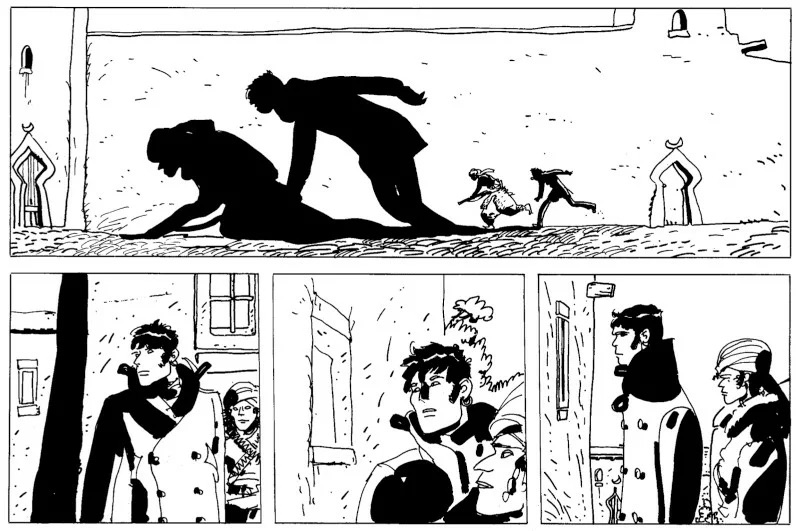
- An immediately recognizable graphic style, full of dynamism yet paradoxically embodied by Corto Maltese, who seems to observe the world motionlessly rather than intervene;
- A kind of authenticity. Dominique Petitfaux, who wrote two books of interviews with Corto Maltese's creator, said: « From the fascist militias of Abyssinia to the dives of Buenos Aires, from life in an Amazonian tribe to the opening of an exhibition of his watercolors at the Grand Palais, Hugo Pratt had accumulated an entirely exceptional experience of life—and of all the possibilities it offers. »1
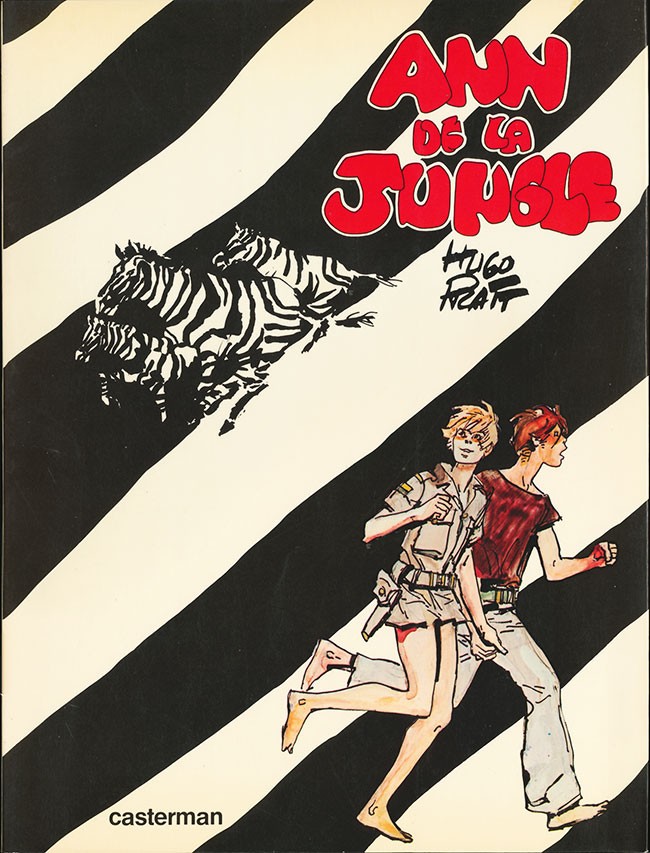
This experience runs through his work, from Fort Wheeling to The Scorpions of the Desert, as well as Ann of the Jungle and, of course, Corto Maltese. Still, here and there, a degree of colonialist condescension can be found.
The Monk's Island
Born in Rimini on June 15, 1927, Pratt began making comics in 1945, notably working on the series Asso di Picche (Ace of Spades) and later the Argentine magazine Misterix (he lived in South America from 1949 to 1962). In 1967, after meeting Florenzo Ivaldi, the magazine Sgt. Kirk was launched, publishing the first pages of The Ballad of the Salty Sea.
The adventurer Corto Maltese, a « gentleman of fortune », made his first appearance there. His introduction—adrift at sea, seemingly crucified on a raft—has become famous. An unreserved romantic, Corto is the son of a British sailor and a Romani mother. As a young man, he carved a line of fortune into his own hand with a razor blade. A pirate of the South Seas, disreputable but just, Corto wears an earring in his right ear.
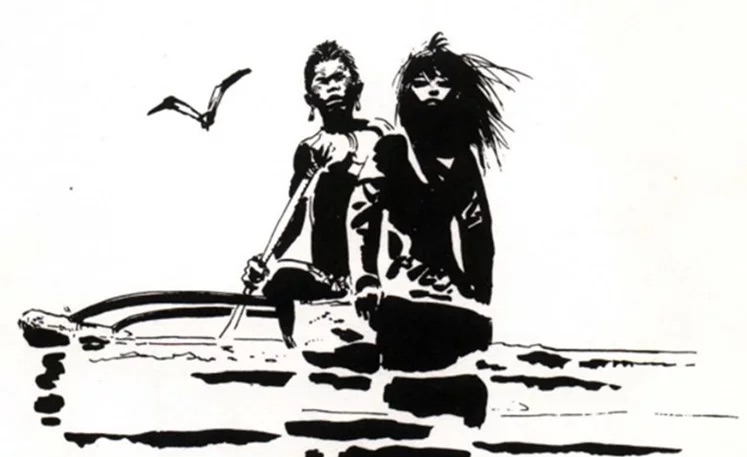
The Ballad... has all the hallmarks of an adventure serial, the format Pratt had been working in since the 1950s. The story takes place in the South Pacific between 1913 and 1915. Corto meets Tarao and Pandora, with whom, according to Pratt, he will spend his final days some fifty years later. There is a mystery: the Monk, a truly mystical figure. An enemy: Rasputin, violent and volatile, who desperately seeks Corto's friendship (Pratt's stories contain little true Machiavellianism: the conflict between the hero and his supposed opposite is full of contradiction and mutual aid). An imaginary island: Escondida. Love stories, full of scope and unspoken feeling, between Corto and Pandora, and between Pandora and Slütter. A drama...
The characters love, take revenge, and forgive one another; the story carries the breath of friendship and honor. Several tales intertwine, forming both a rite-of-passage journey and a story of war, jealousy, and power. For readers who never imagined how much emotion a comic could convey, the first reading of The Ballad... will surely be a revelation, if not a shock.
Unreal yet familiar
Pratt won public and critical recognition relatively late, in the mid-1970s, thirty years after his debut. A writer of novelistic essays and an occasional actor (notably in Leos Carax's Mauvais Sang in 1986), he also saw his albums presented by François Mitterrand to hospitalized racing driver Jacques Laffite. The Ballad... launched a series of albums following Corto Maltese, in which Pratt developed his love of travel, magic, and ships. His greatest later works include The Celts, The Ethiopians, and The Golden House of Samarkand.
Pratt liked to create atmospheres that were both warm and full of ambiguity. We are carried into a world that initially seems unreal, yet feels paradoxically familiar through its staging of famous figures, its relationship with history, and its narrative momentum. His graphic style kept growing more refined until the mid-1970s; as it became increasingly pared down, perhaps in an effort to focus on the essentials, it could sometimes lose expressiveness. But Milo Manara said: « Pratt says he will manage to tell an entire story with a gesture, an imperceptible wink—and I believe him. »
In The Golden House of Samarkand, Pratt once again plunges headlong into adventure, but nothing about the story is ordinary: a series of false leads, MacGuffins, emotionally powerful scenes in which he is unafraid to take his time, and an increasingly dreamlike dimension...
Movement and stasis
In 1986, Pratt described his origins in L'Événement du Jeudi: « Take my family tree. On one side, I descend from Sephardic-Marrano Jews from Toledo who converted to Catholicism, were exiled, and settled in Avignon during the papacy, working as bankers for the Church. The paternal side is even more complex, with its mixture of Byzantines, Turks, Venetian glassblowers from Murano, and English Jacobites loyal to the Stuarts who fled to the Mediterranean. And one day, all these people ended up in Venice. »
At ten, he moved to Abyssinia, where his father, a military officer, had been posted. War had already given him a thousand lives before he was even twenty. In Argentina, he met writer Héctor Oesterheld and initially focused on drawing. It was much later, in France, that he achieved great success. After settling in Switzerland in 1984, he continued to travel widely. In Pratt's work, everything seems to intermingle: melancholy and cynicism, reality and dreams, action and philosophy, movement and stasis. This is also apparent in his art, which sometimes veers toward a kind of impressionism.
Touches of color
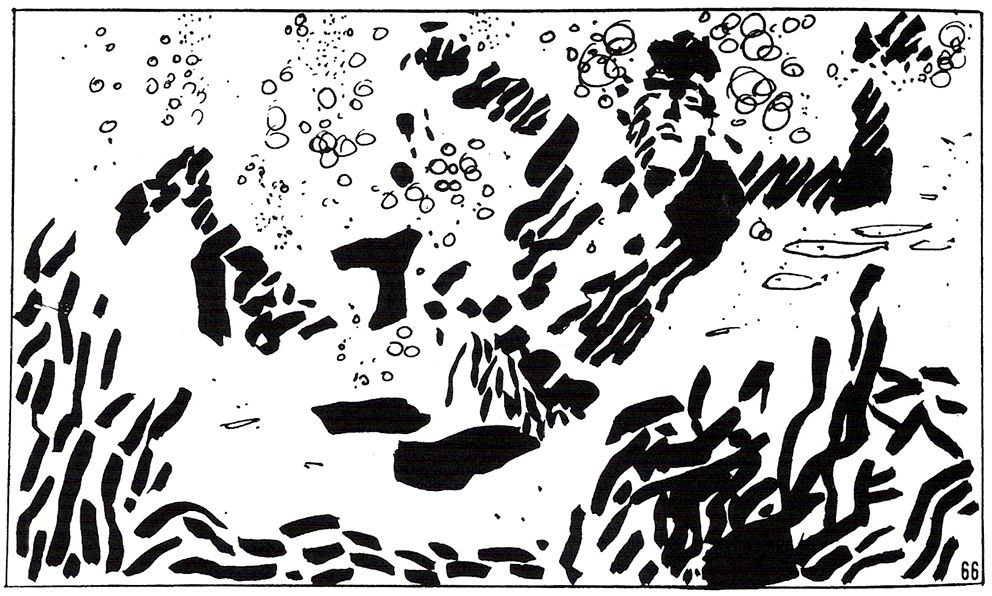
In the 1950s, Hugo Pratt spent a year and a half in London, where he took watercolor classes at the Royal Academy of Watercolor. By then, his black-and-white drawing technique was already exceptional, in the tradition of Alex Raymond, creator of Flash Gordon, among other works. Pratt's use of color grew over time, especially during the last ten years of his life. Many, including Patrick Amsellem, curator of the 2011 exhibition « Hugo Pratt's Imaginary Voyage » at the Pinacothèque de Paris, consider these to be his finest watercolors.
His watercolors embody an exceptionally pure form of the « Pratt line ». Or rather, the line fades away: his coloring seeks the greatest possible beauty with remarkable economy of means. His choice of colors also has the dreamlike, contemplative qualities that run through his work as a whole.
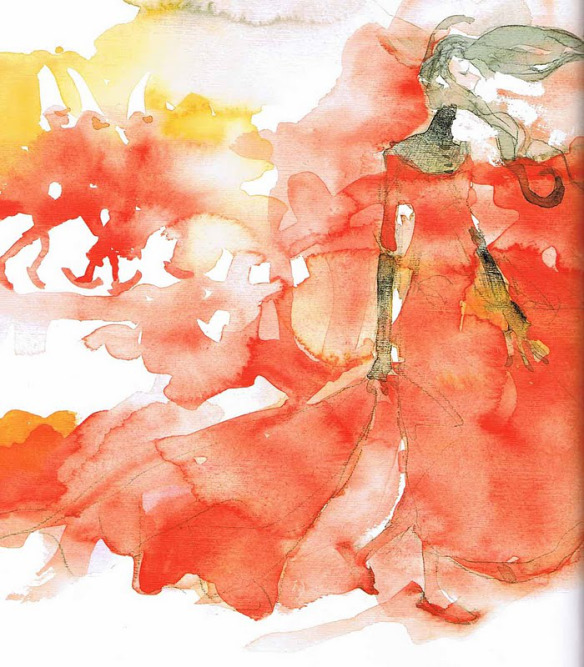
Like Corto Maltese, Pratt seems to approach the world with both urgency and patience. From one continent to another, both embark on adventures and learn how to look. Perhaps that is Pratt's secret: making travel less a destination than a way of remaining on the journey.
◆
Hugo Pratt: Le Désir d'être inutile (Robert Laffont, 1999) ↩︎