
First published as a book by Dargaud in 1979, The Black Order Brigade, together with Hunting Party, published in 1983, forms the landmark diptych by writer Pierre Christin and artist Enki Bilal. A deeply political work, The Black Order Brigade follows a handful of veterans of the International Brigades in the Spanish Civil War.
Forty years after the end of the civil war, a terrorist group known as the « Phalanges... » massacres the inhabitants of a small village. Jefferson B. Pritchard, a journalist in London, recognizes the attackers as former Francoists he fought in the Brigades, now involved in various far-right actions. He decides to reunite his old comrades to track down the perpetrators and kill them. The characters never explicitly say they intend to « finish the job » they began forty years earlier, but the implication is clear.
Is political violence ever justified?
Throughout the comic, the motives of both the terrorists and Pritchard's group remain ambiguous, even obscure. If Pritchard and his comrades stand for justice, it is a deeply personal kind of justice. They are driven as much by nostalgia and revenge as by any sense of doing good. Old and often ill, like the people they confront, they are at once pathetic and tragic, admirable and repellent.
Throughout The Black Order Brigade, it feels as though Pritchard's actions are leading his group straight to disaster. And so they do. They fight one last battle, with the story's silences mirroring what goes unspoken between the characters, who nonetheless seem to know they are heading toward death. The Phalanges terrorists, on whom the story does not dwell, are equally enigmatic; we never really know what they think, especially in the final scene. They are as isolated as Pritchard and his friends, who seem to have no families and no connections beyond their political networks. The characters' unseen personal lives are both troubling and part of the mystery of these lives lived by proxy.
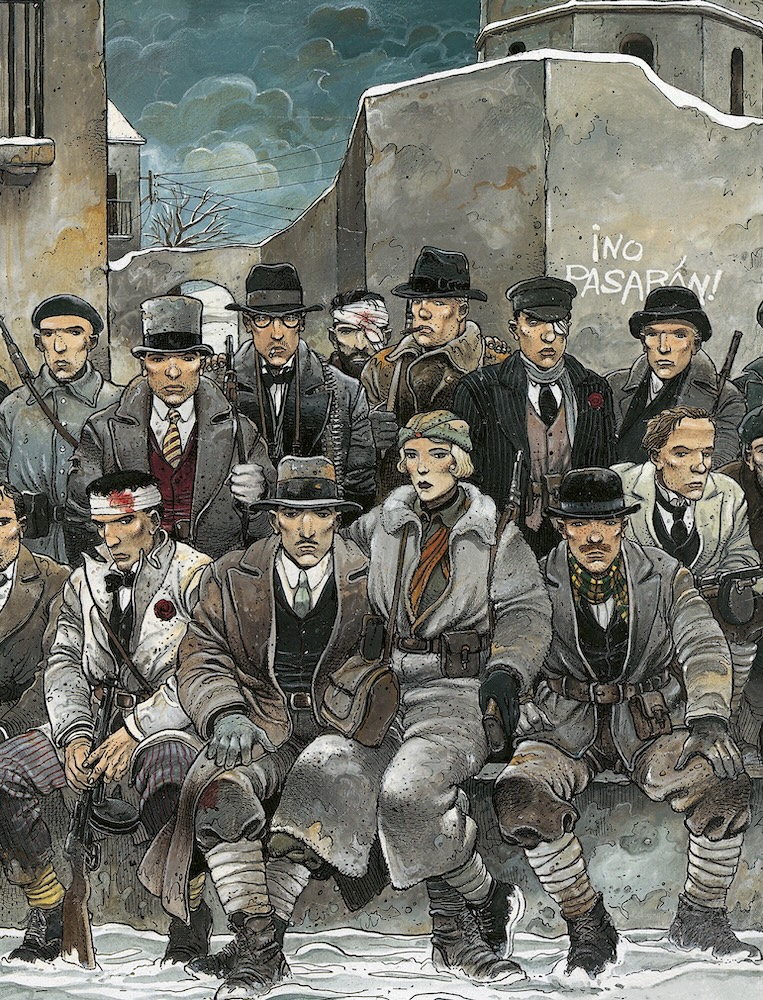
The condemnation of fascism and terrorism is never heavy-handed. The book does lapse into a few simplifications, owing to some looseness in the storytelling, but The Black Order Brigade is unafraid to lay bare the complexity of the forces at work. It is rooted in the political climate of late-1970s Europe, marked by armed violence and resurgent neo-fascism. Above all, it questions the legitimacy of political violence.
The story is dark, and Enki Bilal's stark, angular artwork suits its drama perfectly. Structured like a tragedy, The Black Order Brigade is suffused with melancholy: these old fighters define themselves by the struggle they once waged, and although they now have the chance to fight again, the reasons that once drove them have disappeared.
That will not stop them. What remains is the sad image of Pritchard, deliberately alone, brooding over his memories by the sea.
◆