
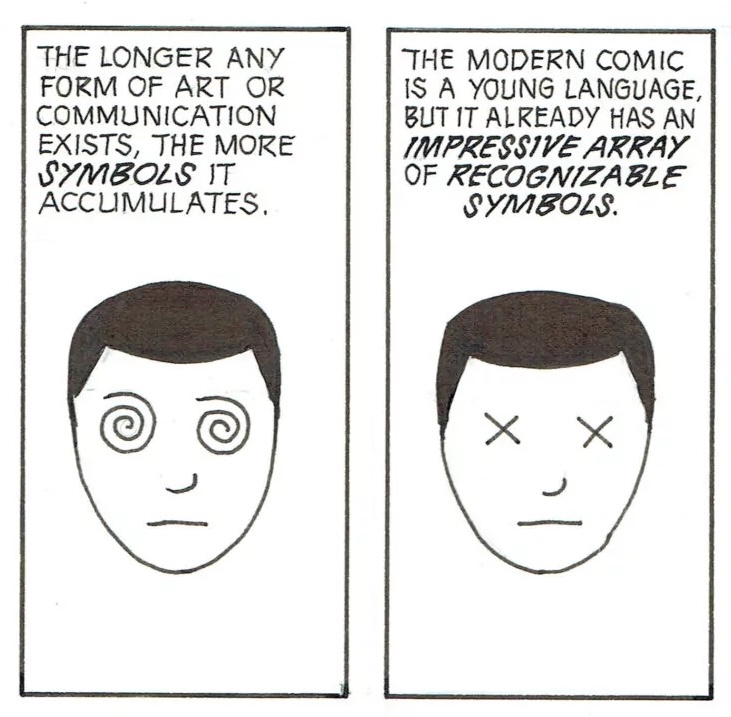
One of the defining features of comics throughout their history has been their use of symbolic abstraction. Comics are a world of symbols: practical symbols (those of language, science, and communication), figurative symbols (images), and abstract symbols representing concepts or ideas. One of the most widespread figurative symbols in comics is the cartoon.
This kind of symbol has a remarkable power of identification because it focuses on very general features. Take, for example, a face represented by a circle, two dots for eyes, and a line for a mouth: this drawing is instantly recognizable as a human face with which it is easy to identify. As Scott McCloud1 explains, this is the power of amplification through simplification.
Language also adds to the cartoon: from sound effects—onomatopoeia such as “splash,” “beep,” “argh,” and so on—to literary writing. The boundary between language and images even disappears in the case of sound effects (McCloud, again).
The inner world
Where realistic drawings let us see the outside world, cartoons (McCloud again) let us see an inner world, one that seems to vibrate with inner life—for instance, the beads of sweat cartoonists make appear on a character's face when they are anxious.
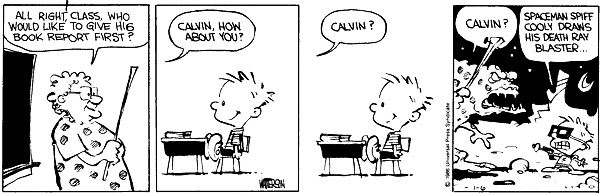
Charles M. Schulz's Peanuts (1950–2000) and Bill Watterson's Calvin & Hobbes (1985–1995) are two of the best-known comic strips in the world, and both use cartooning to depict childhood. It would be wrong, though, to equate cartoons with childishness. In these particular cases, however, the relationship between reality and the inner world is especially clear.
Garry Trudeau, creator of Doonesbury, sees in the character of Calvin « childhood as it actually is, with its constantly shifting frames of reference »2. To the outside world, Hobbes is Calvin's stuffed tiger; to the boy, who plays and talks with him, he is flesh and blood. Calvin sees Hobbes one way, while everyone else sees him differently.
« I show two versions of reality, each making perfect sense to the person seeing it. That's life. Nobody sees the world in exactly the same way, and I literally draw that in the strip, » says Bill Watterson3.
Double meanings and variations
While the term « cartoon » describes a mode of representation, it can also refer to a single, often humorous drawing, with or without an explanatory caption, of the kind found in daily newspapers or periodicals such as The New Yorker.
The term refers to a style rather than a means of distribution or a subject, but some cartoons in this second sense are realistically drawn, or at least based on caricature (more on that later). Most, however, continue to use the techniques of cartooning as defined above. Cartooning also has considerable overlap with visual humor, though the two are not identical.
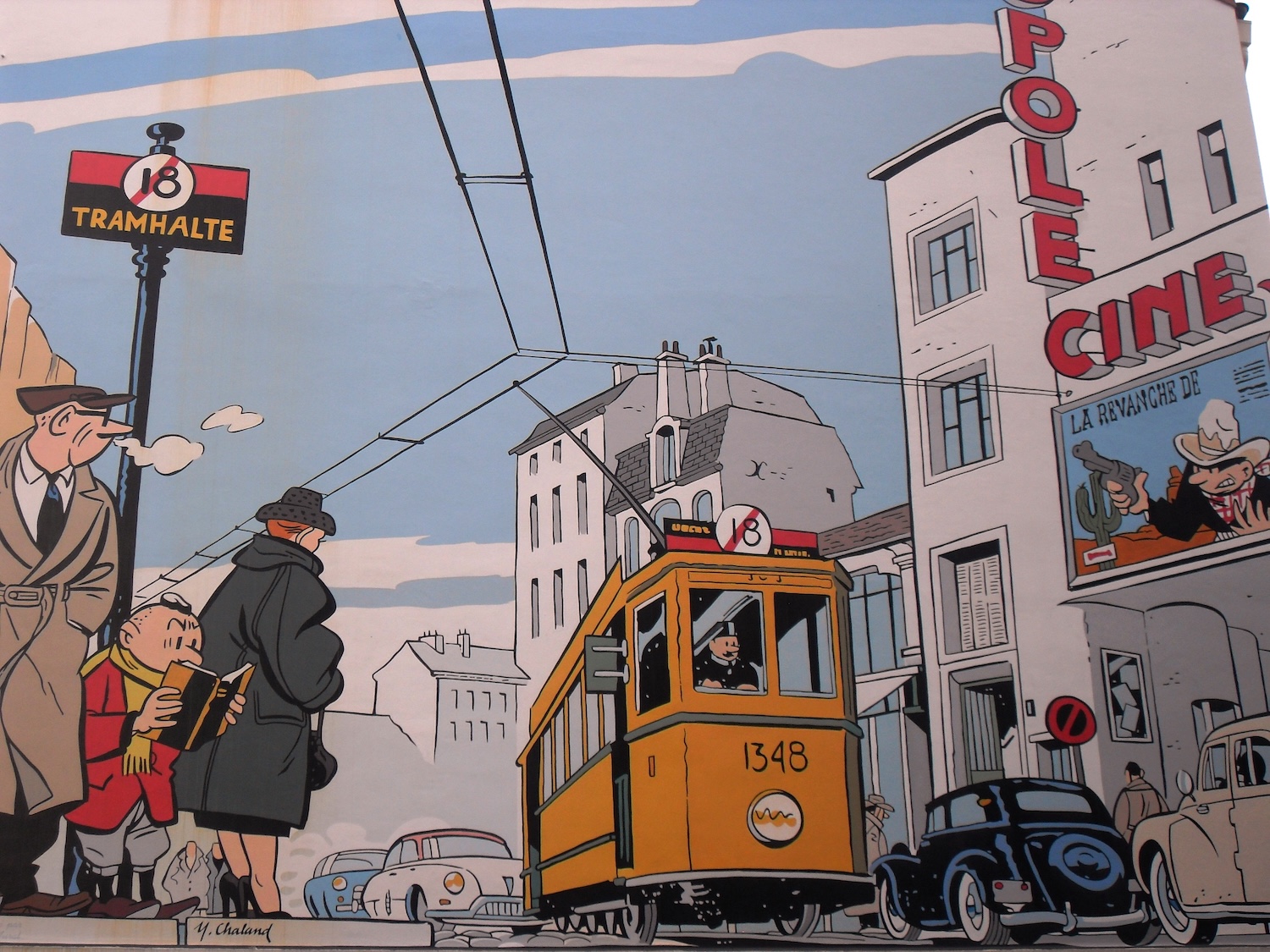
The ligne claire style, also drawing on cartooning but mixed with realism, is especially familiar in Europe. It characterizes much of Franco-Belgian comics from the 1930s through the 1950s and 1960s—a particularly rich and influential movement, launched by Hergé in the late 1920s with his Tintin series and later taken up by creators such as Edgar P. Jacobs (Blake & Mortimer), Bob de Moor (Barelli), Jacques Martin (Alix), and many others.
Ligne claire is characterized by precise drawing, strong outlines, no ostentatious inking effects, and areas of bright color with little shading; it also tends to go hand in hand with a certain rigor in storytelling. Hergé said he was influenced by Alain Saint-Ogan, creator of Zig & Puce in the 1920s, as well as by Chinese art and American comics. For him, drawing style was inseparable from clarity of narrative. Ligne claire, in any case, makes naturalistic representation possible while also encouraging identification among a broad readership.
Mask or identification?
Finally, where is the boundary between cartooning and caricature? Let us go back to Rodolphe Töpffer, a pioneer of comics, and his Essai de physiognomonie, published in 1845. According to Benoît Peeters4, « [His] distinction between permanent and non-permanent features, for example, raises questions that artists ask themselves: how can you make a character immediately recognizable while avoiding turning them into a mere mask? » Beyond this challenge, caricature conveys the particular, while cartooning conveys the universal.
In its traditional sense, the word « cartoon » comes from the Italian « cartone », meaning a thick sheet of paper (cardboard), and referred to preparatory sketches made by painters. The word « sketch » is useful here, as it helps us understand how the concept evolved: from an idea of incompleteness, of something unfinished, to one of semi-abstract identification that is nevertheless immediate and mirror-like. Where less is (definitively) more5.
◆
Understanding Comics: The Invisible Art (Mark Martin, 1993) ↩︎
Foreword to the first Calvin & Hobbes collection (Andrews McMeel Publishing, 1987): « Childhood as it actually is, with its constantly shifting frames of reference » ↩︎
The Calvin and Hobbes Tenth Anniversary Book (Andrews McMeel Publishing, 1995) ↩︎
« Entre caricature et bande dessinée : la vulgarisation par l’image au XIXe siècle. Interview with Benoît Peeters » ↩︎
« Less is more » is attributed to German architect Ludwig Mies van der Rohe, and expresses the idea that beauty lies in simplicity. ↩︎