
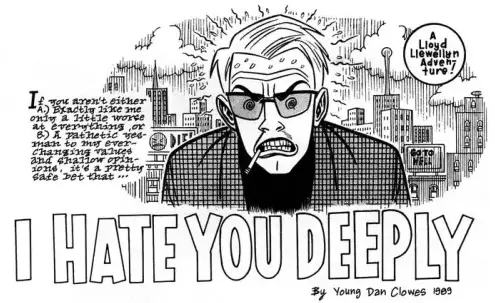
In the 1990s, Dan Clowes became one of the pillars of American independent comics. His periodical, Eightball, published by Fantagraphics since 1989, was one of the most vigorous creative spaces of the decade1, improving with every issue. He began with radical, extremely funny satire (Young Dan Pussey, Grist For The Mill, Art School Confidential—a brilliant tour de force), at times cynical, almost vengeful (I Hate You Deeply), built strange narratives (Like A Velvet Glove Cast In Iron), and then gradually gained in subtlety and scope.
This is first the case with Ghost World (Eightball #11 to #18), which would inspire a brilliant film adaptation2 by Terry Zwigoff (the director of the documentary Crumb), but also with shorter stories such as MCMLXVI (Eightball #16, where Clowes excels at cruel satire), Gynecology, and Caricature.
Unease, parody, but sensitivity
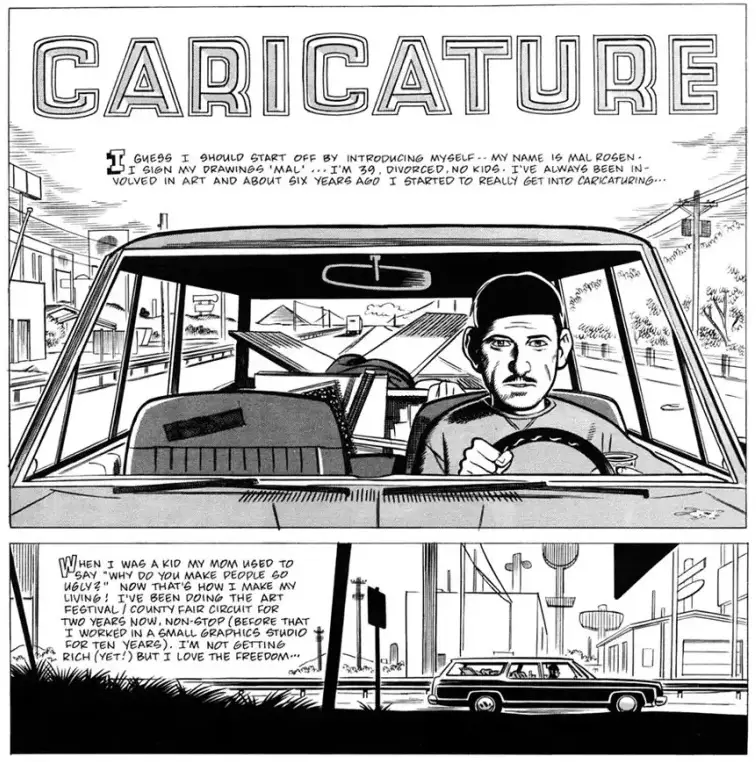
This last story (Eightball #15), published in 1995, is an excellent example of the « second-manner » Clowes, able, in only 16 pages, to weave together a tangle of personal stories and, without handing us the keys, make us feel their full weight.
Caricature is a powerful reflection on the role of art in general and on the notions of « major » and « minor » art. Mal Rosen, a solitary cartoonist with obvious inner turmoil, has a brief, ambiguous relationship with a supposed teenager, Theda (an anagram of death?), who is rather mysterious and very ironic, but just as lost. She toys with Mal while admiring him.
Neither of these characters gets the better part. Not Mal, who falls in love without any real reason, nor Theda, irresponsible and uncertain, whose relationship to art oscillates between disgust (her parents, if her account is to be believed, are celebrities of the art world) and devotion to a form of alternative culture, which Mal represents in her eyes.
Theda's view of Mal's work will trouble him deeply, but his confidence in his talent will paradoxically wither. The ending, rather unsettling, even uncomfortable, leaves the reader (just as much as Mal) in doubt. But the accuracy of the gaze turned on the characters and Dan Clowes's naturalistic approach make Caricature a small masterpiece.
One senses that Clowes is confronting the dysfunctions of American society more and more directly. His pessimism (Give It Up, in Eightball #8) turns into compassion. The distress and loneliness of his urban, middle-class characters, first observed through pure parody (some stories remain clumsy—but the author's radical stance is in itself a statement, as in On Sports, in Eightball #16), are explored through embodied figures, avoiding generalities.
Yes, he exacerbates socially shaped behavioral archetypes, blames everyone's stupidity and the individual's weak inclination to try to escape their own prejudices, but he does so with a sensitive eye. « I'll gladly read something exceptionally stupid and bad as long as the author (...) shows a personal vision3 », he later said. No deus ex machina in Clowes, just men and women awkwardly making their way with what they have.
« I'll gladly read something exceptionally stupid and bad as long as the author (...) shows a personal vision. »Dan Clowes
Contemplate and reflect
To this he adds a sense of the strange reminiscent of David Lynch's universe and a surprising graphic style, sometimes leaning toward cartooning, classical in execution, almost insignificant at first glance (no ostentatious effects), but ultimately marked by an immediately recognizable style.
In the early Eightball issues especially, text is often abundant, to the point that Clowes's work resembles that of an illustrator. His drawing is not very dynamic, but this does not hurt his work or make it any less beautiful. Like his characters, his style is steeped in immobility, like an invitation to contemplation and reflection.
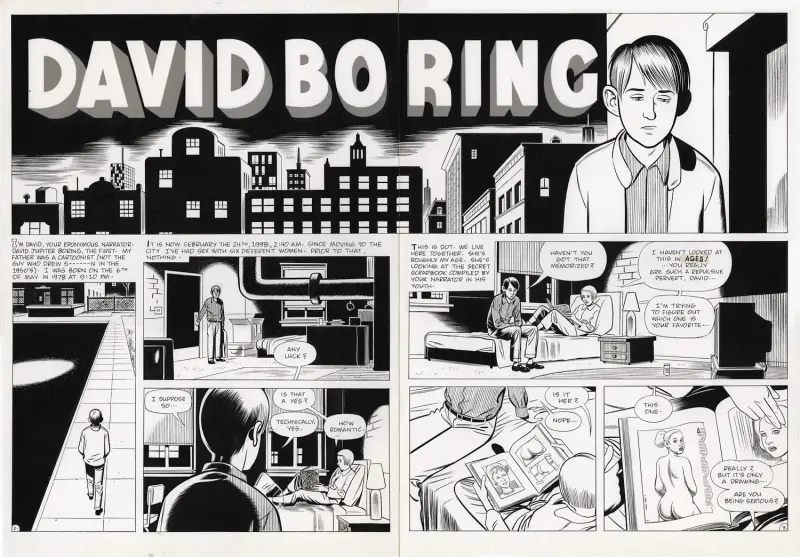
Then comes David Boring (Eightball #19 to #21), which cements his status and astonishes with its ambition, but also its strangeness. Its protagonist, elusive and self-effacing yet nonetheless a ladies' man, is ultimately a typical Dan Clowes character: extremely ambiguous, prone to obsession, and involved in a complex relationship with his lesbian best friend.
But here, his story verges on the epic, even the fantastic. David survives a murder attempt and finds himself stuck on a small island, Hulligan's Warf, for several months, while the world may be tipping into a major bioterrorist conflict.
Built in three acts and totally unpredictable—another Dan Clowes trait—blending social observation, mystery, and catastrophism, David Boring is about isolation, fantasies, and the impossibility of communication. The work4 is rightly considered one of the greatest American graphic novels.
« The primordial infinite of everlasting love »
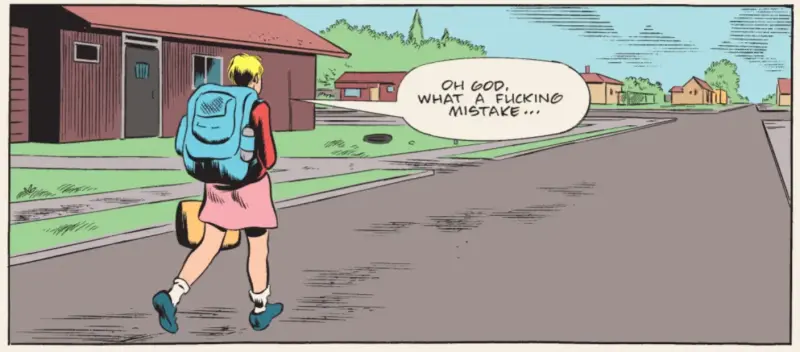
« A cosmic timewarp deathtrip to the primordial infinite of everlasting love », proclaims the cover of Patience (Fantagraphics Books) in 2016. As always with Dan Clowes, this sentence must be taken with a dose of irony, but also, somehow, with great seriousness, or let's say honesty. For Patience is exactly that: a mix of love story, death, and time travel.
Before that, in 2006 Dan Clowes underwent open-heart surgery, contributed to The New Yorker among others, and worked on Wilson (Drawn & Quarterly, 2010), then Mister Wonderful (Pantheon, 2011), two graphic novels that continue the exploration of self-centered characters and experiment with structure and format. Patience followed, his longest graphic novel to date: Jack is married to Patience, who is pregnant, when she is murdered. The story begins as a murder mystery, in which the protagonist, revealing violent impulses, is obsessed with finding the killer. Then the story shifts when Jack obtains a means of time travel.
We understand very quickly that Jack's quest is also a desire for control, that his love for Patience is narcissistic, and that his romanticism permits every transgression. Clowes muddies the waters, as usual, by refusing all sentimentality and painting every aspiration with ambivalence. Formally, he plays with color palettes and, in line with his older works such as Like A Velvet Glove Cast In Iron, uses imagery that sometimes borders on the grotesque, but always in his controlled and offbeat style (notably in contrast to Jack's instability). And what if changing the past, as Jack hopes, meant either losing oneself or confronting a reality one wished to flee?
One more thing
In 2023, seven years after Patience, Dan Clowes published Monica. It is a small event, because it is also a masterpiece. Perhaps even the author's new peak. Monica pushes many of the author's characteristics even further: fragmented narration, multiple registers (intimate, supernatural, even horrific), major ellipses and, at times, conversely, extremely condensed storytelling, a mix of emotion and unease, of reality and dream, unlikable yet touching characters.
Here there is both proliferation (narrative and stylistic), boldness, and, at the same time, coherence: the links are there and allow for accelerations, rebounds, a form of understanding that emerges gradually, like a puzzle. The work seems edited the way a film would be. Reading it demands attention, some aspects remain cryptic, but it is stimulating. A tour de force of freedom and innovation for an author who already has more than 30 years of experience.
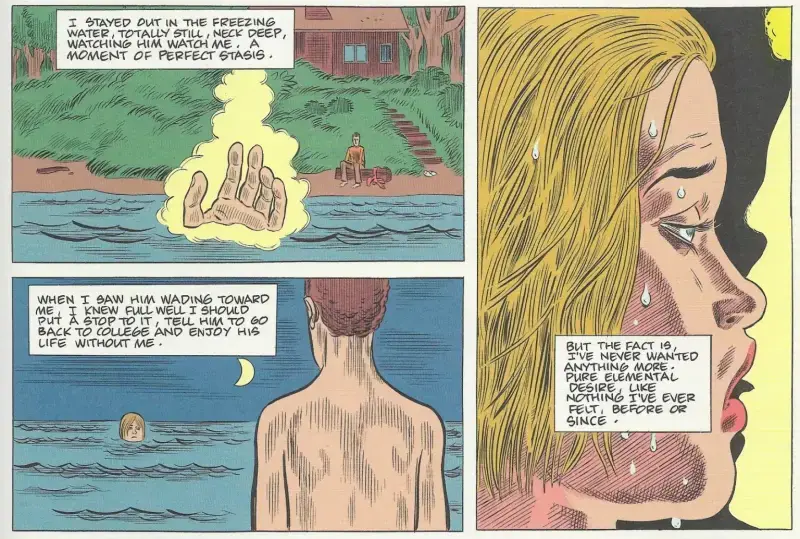
So yes, there is poetry in these interlocking pieces, in his evocative stories, sometimes harsh, often strange, in this accuracy of writing and line that manages to create intensity and precision, combining economy with textual generosity. « I'm more interested in characters who are a little difficult5 », says the author. We too have every right to take an interest in demanding yet limpid authors, like Daniel Clowes.
◆
Clowes would end it in 2004 ↩︎
Two other works by Dan Clowes would be adapted for the screen, Art School Confidential and Wilson ↩︎
« Dan Clowes: Conversations » (Ken Parille and Isaac Cates, 2010) ↩︎
For an in-depth analysis, see this article (in French), originally published in the journal neuvièmeart 2.0 in 2010. ↩︎
« Daniel Clowes: 'You've got to be obsessed' », interview in The Guardian (2010) ↩︎